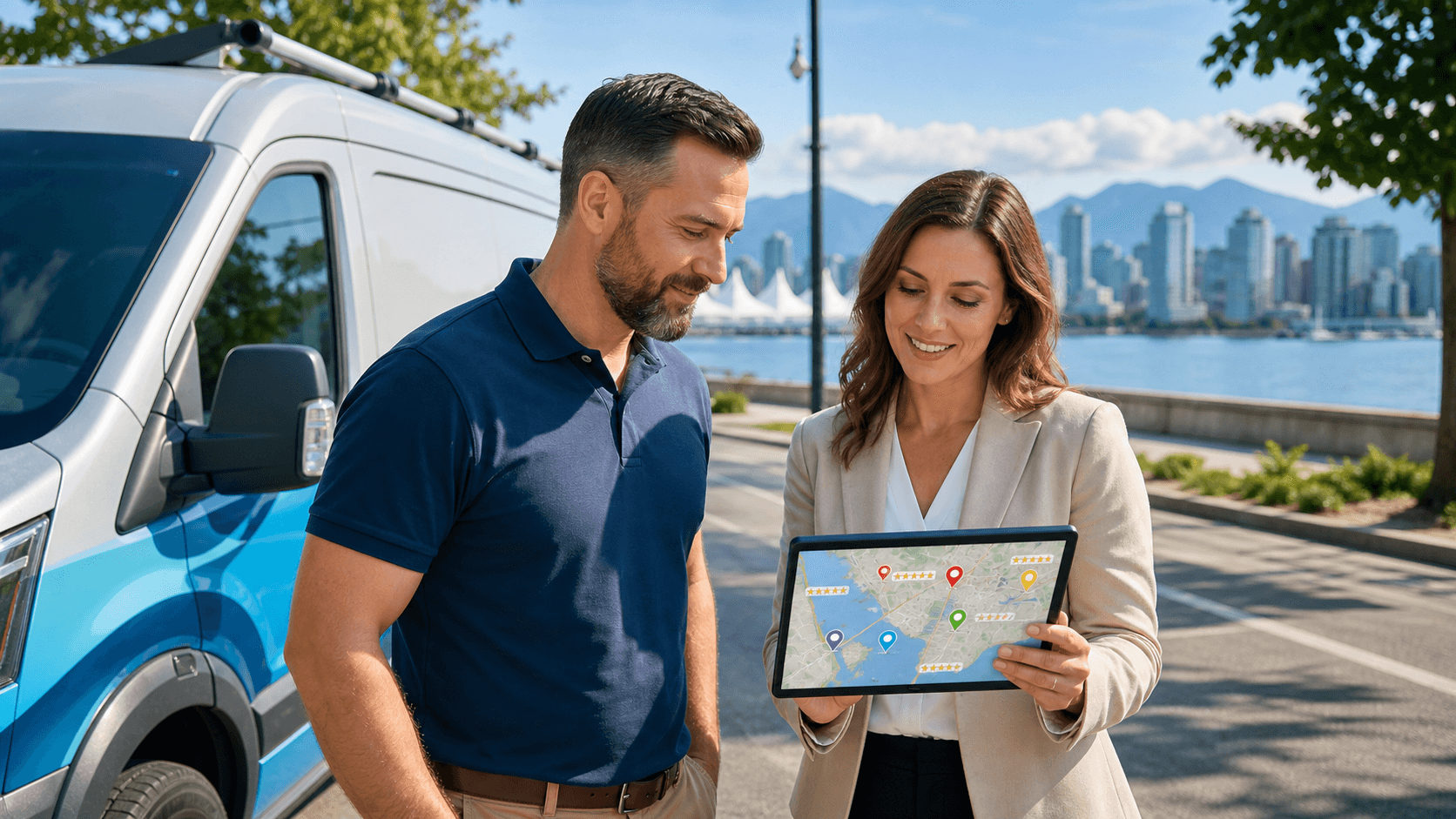
Strengthen Your AI Visibility Foundations in 30 Days
Canadian homeowners now check Google Search, Google Maps, reviews, and even tools like ChatGPT or Gemini long before they pick up the phone. If your business is not clearly showing up in those places, you are losing work to someone who is easier to understand and trust.
Being online is not the same as being understood. That is the AI Visibility Gap. Your business may be searchable, but not easily selectable. People and AI tools see a fuzzy picture, so they skip you. In this guide, we walk through a 30‑day, DIY sprint you can do on a budget to tighten up your signals, so you are more likely to be found, trusted, and chosen. These are the same foundations we use in our human-led SEO and AI Visibility work through SpottableAI, a WebMax Canada service.
How Google and AI Read Your Business
Google Search, Google Maps, and AI-assisted search tools do not see your business like a human driving past your truck. They read signals. The main ones are:
- Clear services
- Clear locations
- Consistent name, address, and phone
- Reviews and responses
- Photos and proof of real work
Searchable to Selectable is the shift from simply showing up to looking like a safe, local, low‑risk hire. When your signals line up, you feel real, nearby, and active. When they do not, people often move on.
Human-led SEO and AI Visibility services, including what we do at SpottableAI, cannot control AI answers or guarantee rankings. What we can do is strengthen the visibility foundations and the signals AI tools may use so they are more likely to understand, include, and fairly consider your business.
Your 30‑day DIY SEO and AI Visibility Sprint
This sprint is built for busy contractors and local service owners. Think 20 to 30 minutes per weekday, or a couple of longer weekend blocks.
Here is the basic plan:
- Week 1: Clarity and cleanup
- Week 2: Google Business Profile and Maps
- Week 3: Reviews, photos, and proof
- Week 4: Content, local mentions, simple tracking
You can do almost everything with free tools like:
- Google Business Profile
- Google Search Console
- Google Analytics
- Google Maps
- A basic spreadsheet
- Free AI tools to help with wording
This is not about tricks. It is about getting your core information clear and consistent so both people and AI tools can understand you.
Week 1: Get Crystal Clear and Consistent
Start by fixing the foundation.
- Create a "master" business sheet
Write down your exact:
- Business name
- Address or service area
- Phone number
- Website
- Regular hours
This is the version you will copy to every listing.
- List services and locations in plain language
Skip fancy terms. Write what a homeowner or property manager would type, such as "furnace repair," "bathroom renovation," "gutter cleaning," or "office cleaning," plus your cities and areas.
- Check your homepage
When someone lands on your homepage, the first screen should clearly say:
- Who you are
- What you do
- Where you work
- Who you serve
If this is missing, plan a simple update.
- Quick visibility checks
- Google your business name and see what comes up. Note old phone numbers, old addresses, or strange listings.
- If you have Google Search Console, log in and note your current search impressions and clicks. If you do not, set it up now so it starts collecting data for later.
Any fuzziness here makes it harder for Google, Maps, and AI tools to correctly describe your business, which feeds the AI Visibility Gap.
Weeks 2 and 3: Maps, Reviews, Photos, and Proof
For local contractors and service businesses, your Google Business Profile is the heart of your online presence. It feeds Google Search, Google Maps, and may inform AI-assisted search.
Week 2 focus: strengthen your profile
- Claim or verify your profile if you have not already.
- Match your name, address, and phone to your master sheet.
- Pick the most accurate primary category, then a few secondary ones if they fit.
- Set your service areas to places you truly work, not the whole province.
- Write a short, clear description like "Residential roofing company serving north Winnipeg and nearby communities."
Add 8 to 15 recent photos:
- Finished jobs
- Work in progress
- Vehicles with logos
- Your team on site
Aim to add at least two new photos every week.
Week 3 focus: reviews and proof
Reviews and project proof are major trust signals. They help move you from searchable to selectable.
Set up a simple review system:
- Create a short text message or email asking for a Google review, with a direct link to your profile.
- Ask every happy customer, right after the job.
- Aim for a realistic number over 30 days, maybe 5 to 10 new reviews.
- Reply to every review in plain language, and where it makes sense, mention the service and city.
Add project proof:
- Put at least one small case study or before/after on your website. Include photos, what you did, the city or area, and the type of customer.
- Repost that same proof on your Google Business Profile as an update and on social, keeping wording about services and locations similar.
These steps show that you are active and local, which is exactly what people and AI tools are scanning for.
Week 4: Content Signals, Tracking, and FAQs
Now that the basics are cleaner, give Google and AI tools more clear language to work with and start measuring change.
Simple content tasks:
- Services page: list each core service with a short, clear description and note your usual areas.
- "Where we work" page: name key cities, neighbourhoods, and the common types of jobs in each.
- One short seasonal blog or project highlight, such as late-summer maintenance, exterior work in warm weather, or prep for colder months for HVAC, roofing, landscaping, cleaning, or renovations.
This content does not guarantee AI rankings, but it strengthens the signals AI tools may use so you are more likely to be included and correctly described.
Basic tracking:
- In Google Business Profile, note weekly views, calls, website clicks, and direction requests.
- In Google Search Console, look at branded searches (your business name) and simple "service + city" phrases.
- Keep a simple spreadsheet with start- and end-of-month numbers for:
- Total reviews and average rating
- Number of recent photos
- Key profile actions, like calls and clicks
Small shifts, like a few more calls from Maps or more profile views, are signs that your visibility foundations are getting stronger.
Common questions we hear:
- What is the AI Visibility Gap for local businesses?
It is the gap between being online and being clearly understood. Your signals might be weak or messy, so tools cannot confidently describe you or suggest you.
- How are AI visibility services different from traditional SEO?
Traditional SEO often focuses on rankings for specific keywords. Human-led SEO and AI Visibility focus on clear, consistent signals across Google Search, Google Maps, and your content so people and AI-assisted tools have a better shot at understanding who you are and where you work.
- Can anyone guarantee that my business will appear in AI answers?
No. No one controls AI answers. You can only strengthen the signals those tools may use.
- How long will these 30‑day changes take to show up?
Some changes, like new photos and reviews, can help fairly quickly. Others, like content updates, may take longer. The goal is steady improvement, not overnight jumps.
- Do I still need a website if I have a strong Google Business Profile?
A strong profile is great, but a clear, simple website gives Google and AI tools more context and proof. Both work together.
- Is this 30‑day sprint enough for competitive trades and busy city centres?
It is a strong start. In more competitive areas, you usually need ongoing, human-led SEO and AI Visibility work on top of this sprint to keep building your signals.
At SpottableAI, a WebMax Canada service, we built our approach around these same simple steps, tuned for Canadian contractors, trades, and local service businesses. The goal is always the same: move you from just being searchable to truly selectable, so more people feel confident choosing you. If you want help reviewing your current signals, we can walk through a practical visibility review with you and suggest clear next steps.
Boost Your Brand's Reach With Smart AI Visibility
Ready to turn your data into real visibility across search, social, and every channel that matters to your customers in Canada and beyond? At SpottableAI, we use our AI visibility services to help you get found by the right people at the right time. We work closely with you to set clear goals, benchmark performance, and refine your strategy as results come in. If you are ready to see what your brand can really do with AI on your side, reach out and let us help you plan the next step.