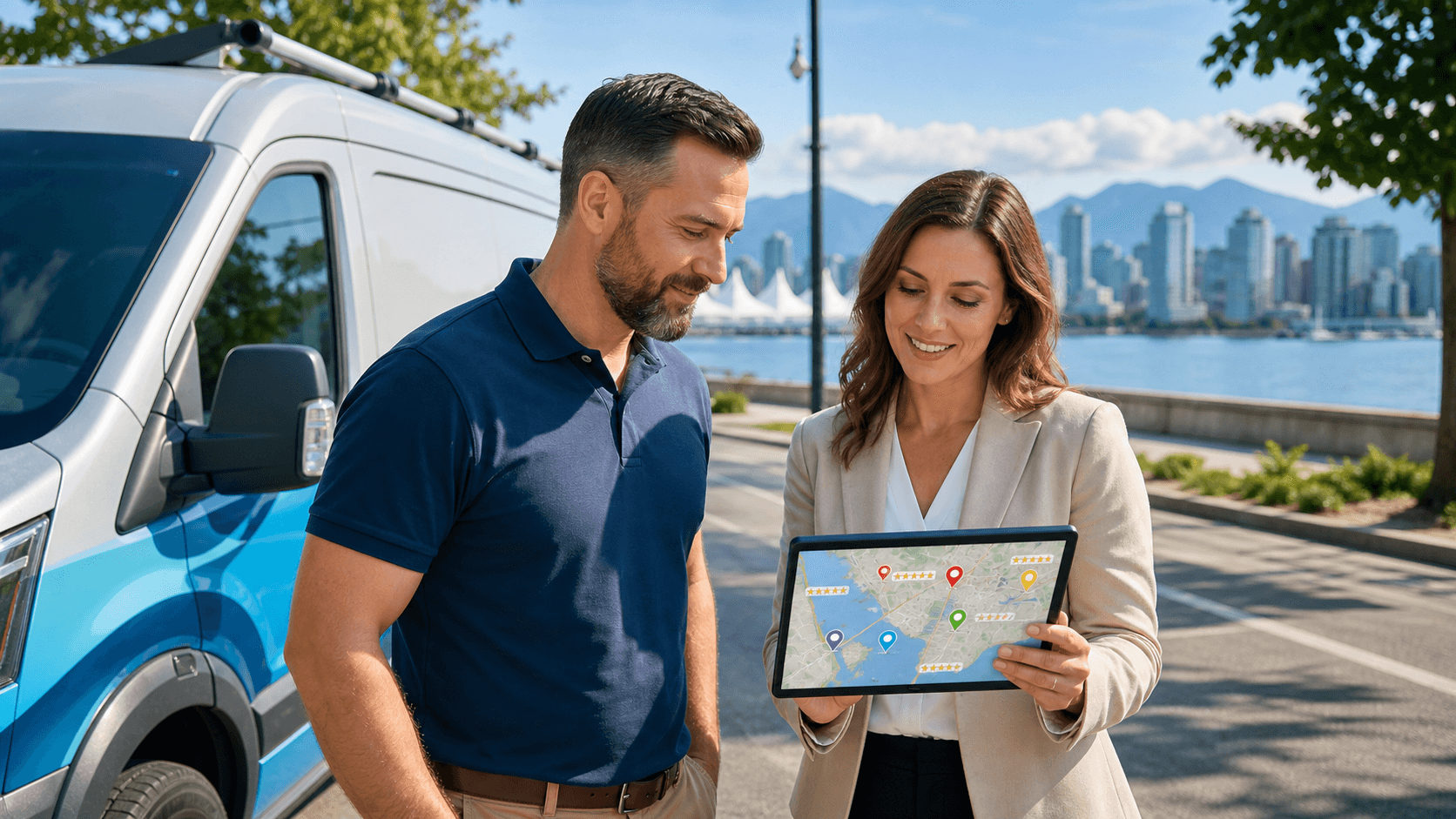
Why Vancouver Contractors Need Sharper Local Signals
When a homeowner in Kitsilano searches for an emergency plumber, they do not scroll for long. They scan the first few clear results in Google, tap into Google Maps, skim reviews, maybe ask an AI assistant, then choose whoever looks close, real, and trustworthy. If your online presence in Vancouver feels fuzzy or confusing, you quietly fall out of that short list.
People now bounce between search, Maps, review sites, and AI tools before they call a contractor. Simply having a website and a Google listing is not enough. You need strong, consistent signals that show what you do, where you work, and why you are a safe choice in specific neighbourhoods. When those signals are mixed, we call that fuzzy signals, and they weaken your chances of being found and chosen. At SpottableAI, a founder-led Canadian service under WebMax Canada, we focus on tightening those signals for local trades and service businesses across the Lower Mainland.
What Fuzzy Signals Look Like in a Vancouver Online Presence
Fuzzy signals are any mixed or unclear pieces of information that make Google, Maps, and AI tools hesitate about your business. In plain language, this can look like:
- Different addresses in different places
- Outdated service areas that do not match where you actually work now
- Vague service descriptions that could fit almost any contractor
- Old citations that were never cleaned up after a move
This is what we call the AI Visibility Gap. When your online presence in Vancouver is fuzzy, AI tools have less confidence to surface you as a strong local option.
We see some patterns specific to local contractors here:
- A business that moved from a home address in Burnaby to a shared shop in East Vancouver but never fixed the old listings
- A site that says "Greater Vancouver" everywhere, yet never names key areas like North Vancouver, Richmond, or Port Coquitlam
- A confusing mix of "we come to you" mobile messaging and "visit our shop" wording, with no clear primary model
Fuzzy signals hurt you twice. First, they make it harder to show up at all. Second, even when you appear in results, people may skip you if your address, service areas, or services feel off. This is why a clear, repeatable workflow to diagnose and fix these issues matters, especially before busy fall and winter seasons for trades.
Step-by-Step Workflow to Map and Sharpen Your Neighbourhood Signals
Step 1: Define your real-world footprint
Before touching any tools, write down what is true in the real world:
- Your main base: storefront, home-based, or mobile service area business
- Your primary municipalities, for example, Vancouver, Burnaby, Surrey, North Vancouver
- Key neighbourhoods that actually drive work, like Kitsilano, Mount Pleasant, or the Tri-Cities
Keep it honest. If you rarely go to Langley, do not pretend you are there every day. Clarity beats trying to be "everywhere".
Step 2: Audit your Google Business Profile (GBP)
Open your GBP and compare it to that real-world list.
- Check your address and service area settings, and remove places you no longer serve
- Confirm your main category and supporting categories fit what you actually do
- Review hours, phone number, and any booking details
- Rewrite your description so it clearly states your core services and main areas, without stuffing it with repeated phrases
Your GBP is often the first "source of truth" that Google, Maps, and AI tools use. If it is fuzzy, everything built on top of it is shaky.
Step 3: Review service pages on your site
Now match your website to that same footprint.
- For each main service, adjust wording so it reflects clear local intent, for example "heat pump installation in East Vancouver" or "drain cleaning for Burnaby condos"
- Group neighbourhoods in a way that feels real, such as Vancouver West Side, North Shore, or Tri-Cities
- Add simple, clear headlines and short paragraphs that state who you help and where
You do not need a separate page for every single neighbourhood, but you do need some structure that lines up with how people actually search.
Step 4: Check your citations and directories
Citations are all the listings that carry your Name, Address, and Phone, usually called NAP.
- Confirm that your NAP is consistent on major listings like Google, Apple Maps, and popular review and directory sites
- Fix old or partial entries, especially any that still show past addresses or wrong phone numbers
- Pay special attention to Vancouver and BC-specific sites, local associations, and trade bodies that matter for contractors and service businesses
Each small fix here removes one more point of confusion.
Step 5: Log everything to prevent new fuzziness
Create a simple spreadsheet with:
- Current details for address, phone, and service areas
- Where each detail appears, such as GBP, key service pages, and main directories
- The corrected version and the date you fixed it
This helps you avoid drifting back into fuzzy territory later, especially when you grow or shift your service area again.
Real Before/After Clarity Examples for Vancouver Trades
Example 1: Vancouver electrician
Before: "Serving Greater Vancouver" on the site, a mailing address in Coquitlam, a GBP pin somewhere in Vancouver, and services listed only as "residential and commercial". Search tools could not tell where this business was really active.
After: Clear focus on East Vancouver and Burnaby. The site has focused pages like "Panel Upgrades in East Vancouver Homes" and "Electrical Repairs in Burnaby Apartments". GBP service areas match this core footprint, and citations share one consistent address and wording. The result is a stronger chance to appear for targeted prompts such as "licensed electrician in East Vancouver condos".
Example 2: North Shore landscaping company
Before: The website mentions "Vancouver and beyond", with scattered references to West Vancouver, North Vancouver, and Squamish. Several old listings still show a past Richmond address. To a homeowner, it is hard to know where this company really works.
After: The footprint is tightened around North and West Vancouver. There is a focused "North Shore Landscaping Services" page, GBP and maps confirm one North Vancouver office, and fresh project photos and reviews clearly tag North Shore locations. Local trust becomes stronger because the story is simple and believable.
These shifts move a contractor from just searchable to more selectable. When your neighbourhood and service story is sharp, people and AI tools both have an easier time saying "yes, this one fits".
Using a Simple Prioritization Matrix to Decide What to Fix First
You likely will not fix everything in one weekend, and that is fine. A simple impact-vs.-effort matrix keeps you focused.
High impact items are the ones that heavily affect being found, trusted, and chosen:
- Core Google Business Profile updates
- Main service pages tied to your top neighbourhoods
- Top citations like Google, Apple Maps, and key local directories
Medium impact items support the story:
- Secondary service pages
- Project galleries with neighbourhood labels
- Neighbourhood-specific FAQs and short case notes
Lower impact items include long-tail blog posts, smaller social profiles, and niche directories. These can still help, just not as much as the core pieces.
On the effort side, start with low to medium effort work, such as:
- Updating GBP categories and description
- Fixing your top five citations
- Adding a clear neighbourhood line to each main service page
Leave high effort items, like changing your main address or restructuring your full site, for when the basics are already clean. As you work through the matrix, you steadily build a clearer and more consistent story that search tools and AI can understand and trust.
How SpottableAI and WebMax Canada Strengthen These Signals
SpottableAI, as a WebMax Canada service based in Canada, focuses on human-led SEO and what we call AI Visibility. Human-led SEO means real people look at your Google profile, service pages, and citations, then clean up conflicts, fuzzy wording, and missing pieces. AI Visibility means we organise your information so AI tools can better understand what you do, where you work, and why you are a solid local choice, without trying to control or guarantee any specific answer.
Contractors, home services, and local service businesses in the Lower Mainland often have mobile teams, shifting service areas, and seasonal patterns. All of that can easily create fuzzy signals. Our work is to tighten those signals so your online presence in Vancouver lines up with your real-world footprint. That way you improve the probability of being found, trusted, and considered across Google Search, Google Maps, and AI-assisted tools when local homeowners need help.
FAQ
How Is This Different From "Regular SEO" Work?
Regular SEO often focuses on broad keywords and large amounts of traffic. Here the focus is very local, on cleaning up how your services and neighbourhoods are described across Google, Maps, and key directories so nearby customers can more easily find, trust, and choose you.
Will This Guarantee Higher Rankings in AI Tools or Google?
No. No one can honestly guarantee rankings or control how AI answers are generated. This work strengthens the signals that search engines and AI tools may use, which can improve the probability that you are surfaced and considered as a good local option.
What If I Serve All of Metro Vancouver, Not Just One Area?
That is fine, but you still need structure. You can group areas, for example Vancouver proper, North Shore, Tri-Cities, and Fraser Valley, and create clear, focused service and location pages so your footprint does not look fuzzy or unbelievable.
Do I Need a Physical Shop Address to Appear in Google Maps?
No. Many contractors and mobile service businesses operate as service area businesses without a public storefront. The key is to set up your Google Business Profile correctly and keep your service areas and contact details consistent across the web.
Can I Do This Audit Myself, or Do I Need SpottableAI?
You can start this yourself with the workflow here, by defining your areas, auditing GBP, service pages, and citations, then choosing what to fix first. SpottableAI, under WebMax Canada, becomes helpful when you want experienced support to move faster and avoid common local visibility mistakes.
Boost Your Local Visibility And Start Attracting Better Clients Today
If you are ready to turn casual browsers into loyal customers, we are here to help refine and elevate your online presence in Vancouver. At SpottableAI, we use data-driven insights to highlight what makes your business unique and make sure the right people actually see it. Tell us about your goals and budget, and we will outline a clear, practical path forward so you can start seeing measurable results faster.