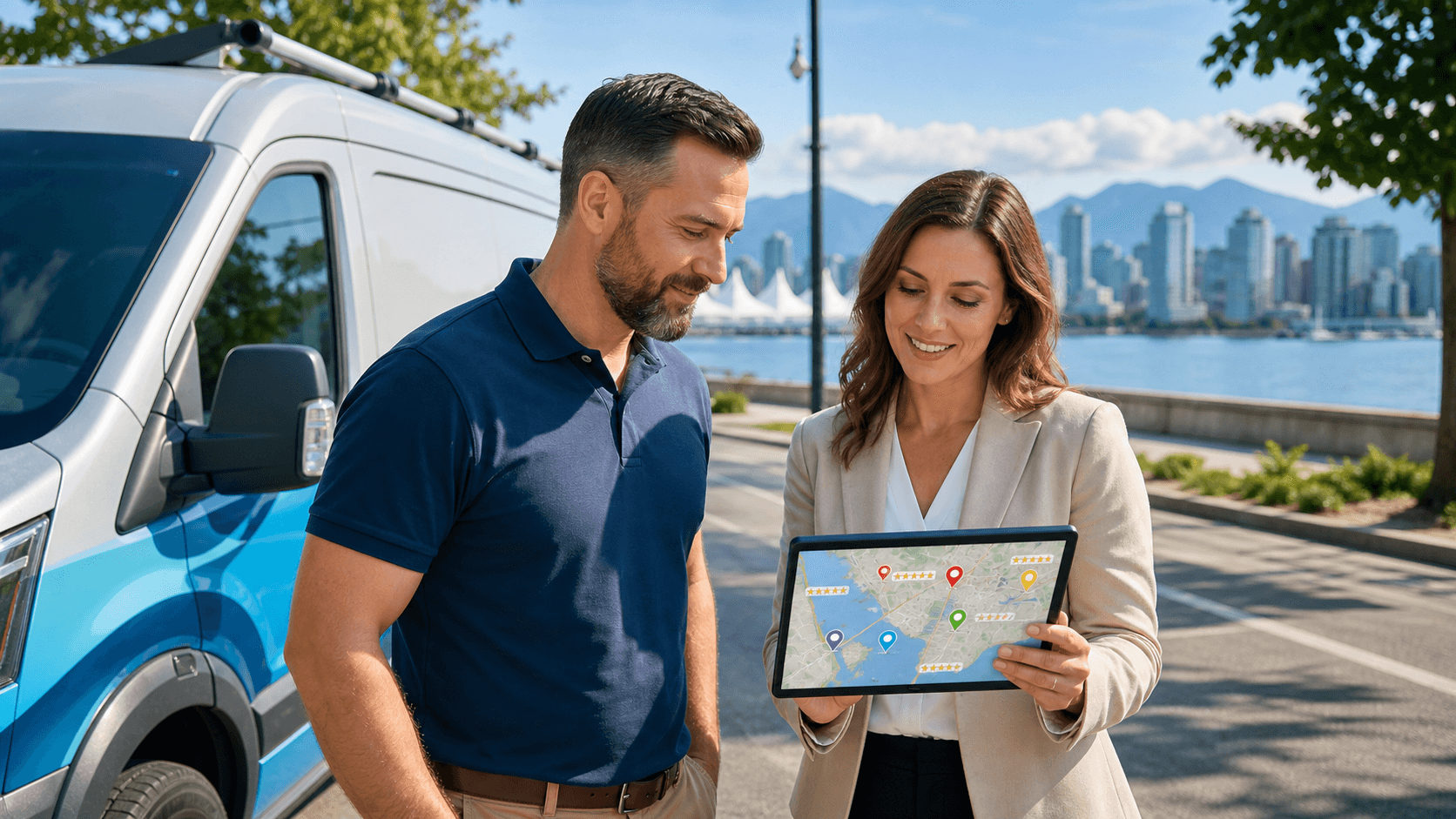
Clear Location Pages for Real-World Customers
People find local services fast now. They search on Google, glance at the map, skim a few reviews, and often ask an AI tool for the "best." Many never scroll very far or click around a full website. They make choices from a handful of quick signals.
This is a big shift for local service businesses. You might have a great team and loyal customers, but if your online details are fuzzy, rushed searchers and AI summaries may skip right past you. Clear, trustworthy location pages on your site help close that gap.
When each location page explains where you are, what you do, and who you serve, it becomes easier for search, Maps, and AI tools to understand your business. That clarity can strengthen the signals these tools may use when they decide which local options to show. For Canadian businesses, mid-summer is often a busy time, so it is smart to check that your online locations match the real places you actually serve.
Why Many Local Businesses Are Hard to Read Online
Many local businesses feel "everywhere" online: a website, a Google Business Profile, a few directory listings, maybe some social profiles. On the surface, that sounds great. The problem is that each place often tells a slightly different version of the story.
Common issues include things like:
- One general Contact page trying to cover multiple locations
- Vague service area text like "we serve the whole city" with no details
- Missing unit or suite numbers on some listings
- Old phone numbers still showing up on random directories
- Different wording for services from one platform to another
From a customer's point of view, this can feel a bit confusing. From the point of view of search engines, Maps, and AI tools, it sends mixed signals. They can see that your business exists, but they may struggle to match it clearly to a specific neighbourhood, city, or service type.
You are not totally invisible; you are just unclear. That lack of clarity can lower the chance of showing up when someone nearby searches for a very specific service. Clear details give these tools more confidence that you are a good match, which improves the probability of being found and considered.
How Search, Maps, and AI Read Your Business Signals
Search engines, Maps, and AI tools do not see your business the way a human on the sidewalk does. They see patterns. They read names, addresses, phone numbers, service descriptions, and reviews across many places and try to decide what fits together.
There are four core signal types that matter a lot:
- Clear services: what you actually do at each location, in plain words people use when they search.
- Clear locations: your exact address, neighbourhood, city, and realistic service area limits.
- Clear trust: reviews, photos, and simple proof points like years in business or local experience.
- Clear consistency: the same key details across your website, profiles, and directories.
AI tools often pull from search results, Maps data, and your own site content when they write short summaries. If those sources line up, the AI has a cleaner picture to work from. That does not guarantee a specific answer, but it helps build stronger visibility foundations.
Think about a plumbing company in Toronto. A specific "Etobicoke Location" page with the exact address, local phone number, nearby intersections, and clear "emergency plumbing and drain cleaning in Etobicoke" text is very clear. It matches up nicely with a Maps listing that says the same thing. That will usually be easier for tools to understand than a single vague "GTA plumbing" paragraph with no clear areas or locations.
The Basics of Strong Location Page Optimization
Location page optimization sounds technical, but it is simple. It just means making each location page on your site clearly explain what you do there, where you do it, and why people can trust you.
A strong location page for a Canadian local service business should include:
- Exact business name, full address, unit number if you have one, and local phone number
- Hours that match your Google Business Profile and other key listings
- A short, clear description of services at that location, using real search language
- Local cues like neighbourhood names, nearby landmarks, parking info, or transit tips
Instead of "we provide complete HVAC solutions," try "we repair and replace residential furnaces and AC units in North York condos and detached homes." Straight, human language beats buzzwords every time.
A bit of extra, helpful detail also goes a long way. You might add:
- Seasonal notes like AC tune-ups before heat waves or snow removal for winter
- Common questions you hear from people in that area
- Any limits on service, like "we focus on homes within a 30-minute drive of this shop"
This is not about gaming algorithms. It is about giving search, Maps, and AI tools a clear, honest picture of your real-world work. When they can understand you better, your odds of being pulled into local results often rise.
Making It Easy for AI and Maps to Connect the Dots
Clear location pages are the base. The next step is helping all your other profiles match those pages, so AI and Maps can join the dots without guesswork.
A few practical moves help a lot:
- Use the same spelling of your business name, address, and phone on every platform
- Link each Google Business Profile to the matching location page, not just your homepage
- Create a simple Locations hub page that lists all locations and links to each full page
- Update old directory listings so they match your current details as closely as possible
This kind of consistency reduces confusion. When your website, Maps listings, and other profiles all echo the same clear information, the overall pattern is stronger. AI tools that pull from these sources see one steady story instead of many loose pieces.
Here are quick answers to two common questions we hear.
- Do I need a page for every city I drive to?
No. There is a difference between a real location and a wider service area. Focus location pages on actual offices, shops, or well-defined primary areas where you are truly based. You can still mention nearby towns in your content, but keep the main page tied to a real location.
- Is this just for big chains?
Not at all. Even a solo, founder-led business with one or two locations can benefit from one strong, well-structured location page. Clarity helps at every size.
How SpottableAI Supports Clearer Location Signals
SpottableAI is a founder-led Canadian SEO and AI visibility consultancy, and this is the kind of work we focus on every day. We care about human-led strategy, not shortcuts or hype.
For location page optimization, we usually help by:
- Auditing your existing pages and profiles to spot gaps, mismatches, and mixed signals
- Rewriting or building location pages in plain language, with real local cues and service terms people actually search for
- Aligning your website content with your Google Business Profiles, Maps listings, and key Canadian directories to create a more consistent footprint
What we aim to do is strengthen the signals search, Maps, and AI tools may use, so your business is easier to interpret and more likely to be found and considered. We do not claim guaranteed AI rankings or control over exactly how you appear in an AI answer. Instead, we focus on the visibility foundations you can really influence.
Because we are based in Canada and founder-led, we pay close attention to how local demand shifts with seasons, neighbourhoods, and weather. The way people in a downtown condo search for help can be different from someone on a rural road, and your location pages should reflect that real-world pattern.
Take the Next Small Step Toward Clearer Visibility
A simple first step is to look at your current location pages or even just your Contact page with fresh eyes. Ask yourself: "Could a stranger understand what we do here, who we serve in this area, and how to reach us quickly?" If the answer feels shaky, there is room to improve the signals you are sending.
At SpottableAI, we often start with a focused visibility review of one key location. We look at your website page, your Google Business Profile, and how you show up in search, then point out unclear signals and simple wins you can act on.
When your location pages are clear, consistent, and grounded in the real places you serve, you make it easier for search, Maps, and AI tools to recognize your business. You are not chasing algorithms. You are building clearer visibility foundations so more local customers can spot you when they need you most.
Get Started With Your Project Today
If you are ready to turn more local searches into real customers, we are here to help you put a clear strategy in place. At SpottableAI, we use data-driven location page optimization to align your content with how people actually search in your area. We will work with you to identify gaps, refine your pages, and track the impact on your visibility and leads. Reach out today so we can map out your next steps and move your project forward with confidence.